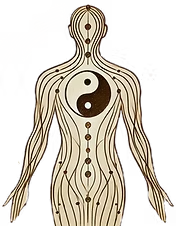
Chinese Energetics: A Tradition of Health for contemporary challenges
Chinese Energetics is the science of the
body's energy system of Chinese Medicine.
It is based on a systemic vision of health,
integrating the interdependence
between physiological, emotional, and mental functions.
The foundational medical texts, Huangdi Neijing and Shang Han Lun,
have modeled the regulation of the body’s energy system through the 12 meridians,
and precisely identified the mechanisms through which
dysfunctions and diseases emerge, evolve, or resolve.
These principles, still in use today in acupuncture and herbal medicine,
provide the foundation for the understanding of the living body.
Chinese Energetics reactivates these principles
through a structured, non-invasive manual method
centered on meridian reflex points that present specific electrophysiological properties.
This approach aims to restore the body’s natural self-regulation capacities,
without the use of needles or external substances.
It acts on organic, neurovegetative, hormonal, and musculoskeletal systems,
while supporting emotional balance and mental clarity.
Its standardized, teachable, and reproducible protocol
enables its integration into clinical, educational, and preventive health structures,
entirely in line with modern public health goals and challenges.
A French lineage into Chinese traditions
Since the early 20th century, a French lineage of practitioners
has structured a functional approach,
beyond the usual protocol-based techniques.
Transmitted from master to student,
it evolves through rigorous clinical practice and
the integration of contemporary scientific models.
George Soulié de Morant, a French consul in China in the early 20th century, initiated this transmission in 1929 by faithfully translating classical texts. He founded the Western approach to traditional Chinese medicine.
Dr. Jean-François Borsarello, a renowned acupuncturist and physician, embedded this legacy within a clinically rigorous practice and trained generations of French practitioners.
His student, Jacques Pialoux, a visionary researcher, introduced a multidimensional understanding of the energetic system, seeking coherence between structure, function, and consciousness. Together with Jacques Martin-Hartz, a Swiss engineer and sinologist, they produced anatomical and energetic maps that illustrate meridian networks, reflex points, and functional interconnections — with unique electrophysiological accuracy.
Régis Blin, international reference in Chinese Energetics, co-founder of SFERE in France and founder of the San Yuan Institute in Taiwan, developed a complete manual method addressing the 12 meridians, 8 extraordinary vessels and endocrine glands, as well as the release of tension stored in bones and marrow.
He mapped specific correspondences between vertebrae and organ functions, formalized the concept of emotional chains (zones of somatic imprinting), and developed an advanced application of the Yi Jing for reading human energetic dynamics.
His student, Martial Nesselbusch, practitioner and instructor, carries this living transmission into the 21st century. He leads clinical practice at the BioHealth Clinic in Dubai, develops a structured international education program, and supports the scientific, educational, and institutional standardization of the method.
À PROPOS
Lorem Ipsum is simply dummy text of the printing and typesetting industry. Lorem Ipsum has been the industry's.
Créé avec ©systeme.io


